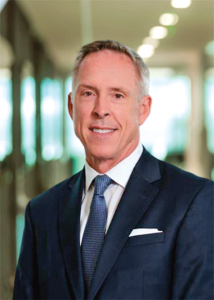
JKV Executive Leadership’s Presence On-Site Provides Calm During a Storm

When all indicators warned South Florida would feel a significant impact from Hurricane Milton, the John Knox Village Executive Leadership team jumped into action putting the residents’ safety first. According to Chief Financial Officer Doug Folsom, “We truly embody the ‘boots on the ground’ approach. Being present on-site during critical situations like Hurricane Milton ensures that residents’ needs and safety are prioritized in real-time. Instead of managing from a distance, we address concerns and challenges as they arise.”


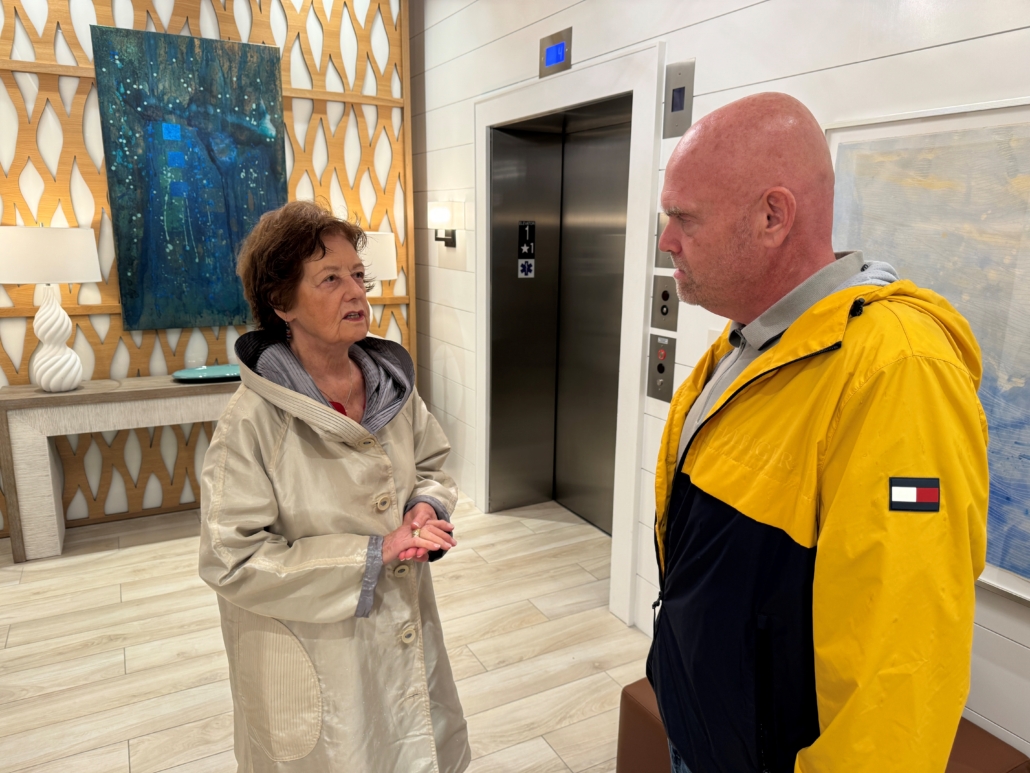
concerned senior woman wearing trench coat talking to leader wearing raincoat

JKV Resident Carol R. discusses storm preparation with CFO Doug Folsom


The dedication shown by the team before, during, and after natural disasters is a prime example of exceptional leadership and care. By tirelessly securing the 70-acre campus and spending the night on-site, they ensured the safety of both independent and more vulnerable residents in higher care areas.

This commitment to being physically present during such a critical time highlights their “boots on the ground” approach and reinforces trust and a strong sense of community.


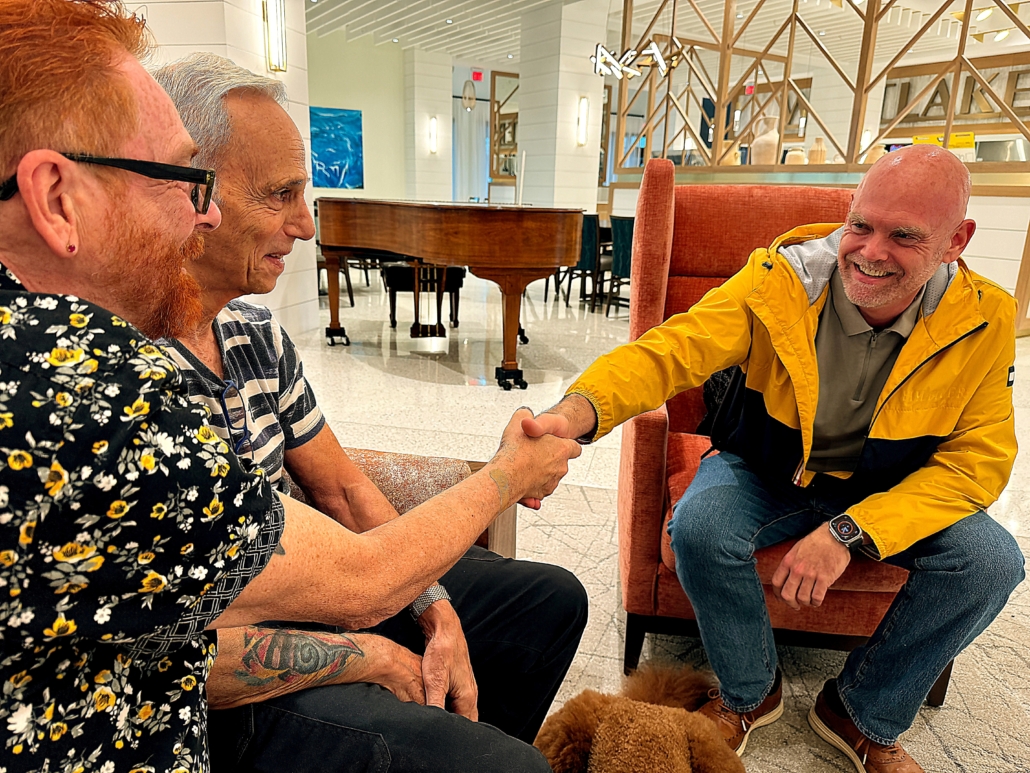
Two men seated on couch shaking hands with seated leader in raincoat

JKV Residents Runar R. and Robert P. with Doug


Their efforts to quickly resume Dining, Lifestyle, and Fitness activities after the storm further demonstrate their ability to restore normalcy and provide comfort to the residents. The residents’ gratitude reflects how their proactive and hands-on leadership contributes to a secure and supportive environment at JKV.

With its five apartment buildings and three villa neighborhoods, JKV is a not-for-profit, internationally award-winning continuing care life-plan retirement community of choice for those seeking an upscale, enriched lifestyle that provides long-term medical care for its residents.

For 57 years, JKV has allowed realistic seniors to plan for their future healthcare needs while enjoying resort-style amenities, life-long learning programs, and a full range of services that promote wellness of mind, body, and spirit. Through unwavering commitment to excellence and guiding principles, the team brings the unique JKV experience to life every day for nearly 1,000 residents.

JKV residents are entitled to unlimited use of healthcare services on campus, with 24/7 Emergency Medical Technicians. JKV has three healthcare residences with assisted, skilled nursing, and supportive memory care in The Woodlands, Seaside Cove, and Gardens West. The Woodlands is Florida’s first GREEN HOUSE® Project that is the most comprehensive effort to reinvent the nursing home recognized by the Governor’s Gold Seal for “Skilled Nursing Center in Broward and Miami-Dade Counties.”

To learn more, join us for an informative lunch on Thursday, November 7th at 11 AM.

To RSVP, call 954-783-4040.

Want to learn more about what John Knox Village has to offer?  Contact us today to take a tour, or for a no-pressure conversation with one of our Life Plan Consultants. 

older woman with long hair taking notes sitting at a desk in front of a laptop

John Knox Village 101: Answers To Frequently Asked Questions

Making the decision about where to spend one’s golden years is a significant one, and many in the 62-plus set are turning their attention towards life-plan continuing care retirement communities (CCRCs)—such as John Knox Village—as a promising option.

As South Florida’s premier CCRC, JKV offers a comprehensive living solution with the appealing blend of independent living, assisted living, supportive memory care and nursing care—all within 70 beautiful botanical acres in the hidden-jewel city of Pompano Beach, Florida.

Given the interest and common queries around this topic, let’s delve into some of the questions JKV’s Life Plan Consultants are asked daily.

What Is A Life-Plan Contract?

A Life-Plan Contract is an insured agreement between you and the community that entitles you to live in one of our independent living apartment or villa homes. Because residents are purchasing a life-plan insurance contract, all CCRCs in Florida are regulated by the Office of Insurance Regulation as specialty insurers, and the Agency for Health Care Administration (AHCA) regulates the provisions of health care.

If, or when, your health situation changes, as a JKV Life-Plan resident, you are entitled to the unlimited use of Gardens West, our assisted living residence, as well as our highly rated rehab, long-term nursing, and memory support centers, The Woodlands, and Seaside Cove.

Paying the one-time Life-Plan entrance fee assures you of a lifetime of unlimited healthcare services. Choosing a CCRC means you will know where, and from whom, you will receive healthcare and that your loved ones will be spared the difficulty of making care decisions during a health crisis.

What Is JKV?

JKV is celebrating its 57th anniversary of providing a holistic approach to retirement living, focusing on health, wellness, and an enriched lifestyle. Residents have the peace of mind knowing they will enjoy a continuum of care designed to meet their changing needs as they age—spanning independent living, assisted living, supportive memory care, and skilled nursing care.

Residents enjoy a rich tapestry of amenities, including an Aquatic Complex boasting resort-style and lap pools, seven dining venues, fitness studios, cultural and recreational activities, award-winning life enrichment programming and beautifully landscaped grounds, all nestled on a picturesque 70-acre campus.

As a not-for-profit CCRC, our dedicated team of professionals delivers personalized care with compassion and respect, ensuring peace of mind for both residents and their families.

Isn’t It Better To Wait To Move To JKV?

Senior living experts agree that the best time to make a move is while you’re active and enjoying good health. At JKV you must be at least 62 to purchase a life-plan contract.

Additionally, moving to a CCRC, like JKV, also safeguards your assets from future healthcare costs should you need care. Assisted living, skilled nursing, and memory support expenses can quickly add up and create financial stress for you or your family if you’re unprepared.

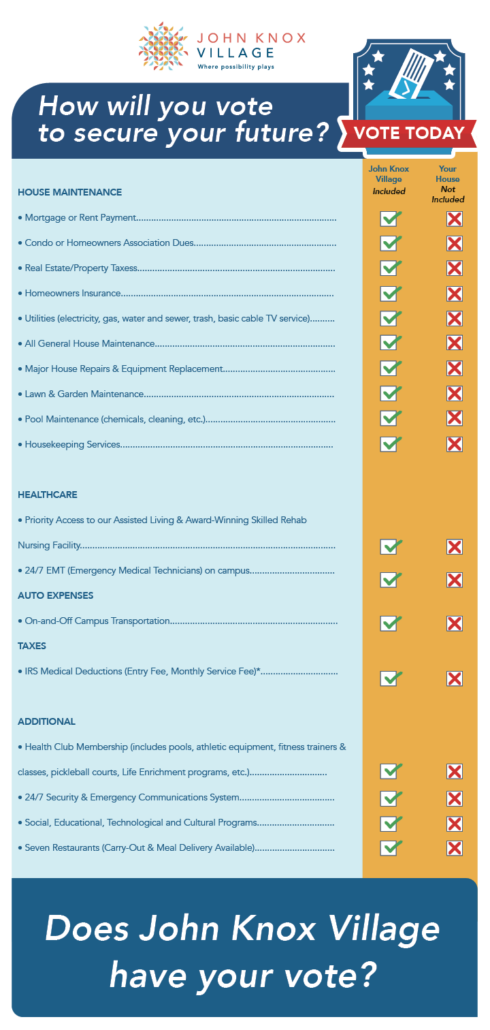
Also, consider costs like home repairs, property taxes, and homeowner’s insurance. Moving to a CCRC eliminates these costs as well as the worry and expense of maintaining a home. For a detailed side-by-side comparison of expenses covered while living at JKV compared with staying in your house, talk to a member of our professional staff.

We all hope to be healthy far into our senior years, but the future is unpredictable and procrastinating a move puts you at risk of not passing the health assessment required for admission.

What Fees Do JKV Residents Pay?

As a JKV resident, you will pay a one-time Entrance Fee, along with a Monthly Service Fee (MSF). The MSF includes all maintenance on your apartment home or villa, housekeeping, a dining plan and use of all the incredible on-campus amenities.

Most importantly, you will be covered for future healthcare costs as outlined in your life-care contract.

Are There Tax Benefits To Living In A CCRC?

You may be eligible for significant IRS medical deductions on both the Entrance Fee and Monthly Service Fee. We recommend consulting a professional financial planner to help determine your eligibility for deductions. A member of our professional staff can also answer your questions and provide details.

What Types Of Residences Are Available?

We offer residences ranging from one to two-bedroom with den apartment homes, with many sizes and floorplans available. In addition, we offer villas, which are single-story attached homes with one-and two-bedroom floorplans.

Will I Need Insurance?

JKV provides insurance for the buildings and grounds. As a resident, your only insurance need would be a renter’s policy to cover personal property and liability.

Can I Decorate My Residence?

Yes! You may furnish and decorate your apartment or villa home to reflect your personal taste.

Is JKV Pet-Friendly?

Yes! Many residents have furry and feathered friends who also call JKV home. We have a dedicated Wellness Park on campus warmly referred to as the JKV Dog Park.

If you have additional questions or are interested in learning more, contact us today and a JKV Life-Plan Consultant will be happy to provide the answers you need or assist you with scheduling a visit to John Knox Village.

Welcome to CFO in the Know – Your Financial Questions About Life Plan Communities Answered

Douglas Folsom, CFO (Chief Financial Officer), has been with John Knox Village for six years, serving as its Controller prior to being named Chief Financial Officer in 2023. He has been at the forefront of the Village’s fast but disciplined growth while keeping a close eye on JKV’s financial steadiness. He is often asked important questions regarding living at JKV, which is why we started this informative series—to help you make well-educated decisions regarding your future.


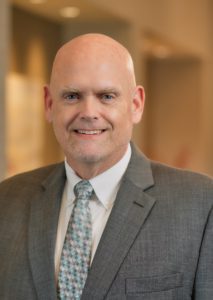
Headshot of Doug Folsom, CFO, John Knox Village

Douglas Folsom, Chief Financial Officer, JKV


Dear Doug:  Is moving to a Life-Plan Continuing Care Retirement Community (CCRC) like John Knox Village a wise investment? — Undecided in Deerfield

Dear Undecided in Deerfield,

As the CFO at John Knox Village (JKV), I would consider it a wise investment for several reasons. Firstly, it provides comprehensive care and services under one roof, offering residents stability and familiarity as their health needs change. A Life-Plan Community, like JKV, ensures access to a full continuum of healthcare options, from independent living to assisted living, skilled nursing, and supportive memory care. This guarantees that as your health evolves, you remain within the same community, surrounded by familiar faces and settings, alleviating the stress of relocating during a health crisis.

Financially, it makes sense to invest in a Life-Plan Community, like JKV. The cost of healthcare, particularly long-term care, continues to rise in the U.S., making it essential to plan proactively. By paying a Life-Plan entrance fee, you secure lifetime access to unlimited healthcare services, which can provide significant financial stability.

For example, a non-JKV resident in skilled nursing care would pay privately an average of $15,000 per month, versus a Life-Plan resident paying a current average monthly service fee of $5,000 – a significant cost savings! This is particularly important given the unpredictability of healthcare needs and costs.

Additionally, a Life-Plan Community, like JKV, offers a rewarding lifestyle, filled with rich social and cultural experiences, peace of mind, and a sense of security. Many of our residents would recommend considering a CCRC as it provides quality care and ensures that residents do not become a burden to their families or the state as they age.

By choosing John Knox Village, you are making a sound investment in your future that not only ensures access to high-quality healthcare, but also promotes an active, purposeful, and fulfilling retirement.

Voting ballet with side by side comparison of benefits of living at a life plan community versus staying at home


senior couple sitting poolside with legs in the water splashing each other

About John Knox Village

John Knox Village, set on a scenic 70-acre campus, is South Florida’s leading life plan or continuing care retirement community, celebrating 57 years of excellence.

JKV offers a comprehensive approach to retirement with a continuum of care including independent living, assisted living, memory care, and skilled nursing. Our elegant residences, vibrant community, and extensive amenities—including an Aquatic Complex, diverse dining options, fitness centers, and cultural activities—ensure comfort and promote enrichment.

Our caring team is committed to providing personalized support in a life plan community, delivering peace of mind for residents and their families.

Interested in learning more about John Knox Village? Contact us today for a no-pressure conversation with a Life Plan Consultant, or to schedule a visit.

senior couple meeting with a financial advisor

Avoid the Most Common Estate-Planning Disasters

It takes time to build wealth, create trusts and develop an estate plan to protect and preserve one’s assets for future generations.


Scott Montgomery, CLU, ChFC       By Scott Montgomery, CLU, ChFC


Annual reviews of your financial accounts are critical to ensuring your wishes are followed after you are gone.

Whether you do this at the start of the year or after filing your tax returns, check how your accounts are titled and who is named beneficiaries to ensure this information matches your current life circumstances and evolving tax laws.

A mistitled financial account or lack of a named beneficiary can lead to a wide array of potential problems down the road. For example, if it has been several years since you last updated your retirement plan’s beneficiary designation form, the assets you intend to pass to a current spouse or children may end up in the hands of a former spouse. Instead, make it a habit to regularly review your estate plan and ensure your assets are adequately protected within the context of current laws, including the tax code.

Account Ownership

The law provides individuals with options for structuring ownership of real and personal property, including bank accounts, brokerage accounts and retirement savings accounts. How these assets are titled, especially when they are owned by two or more people, can help to avoid probate at the time of one account owner’s death and limit exposure to potential legal judgments and tax liabilities in the future.

Joint Tenancy with Rights of Survivorship allows property owned by a deceased individual to pass outside of probate directly to the other property owner(s), who consequently can receive a step-up in their share of the property’s cost basis and minimize their exposure to capital gain taxes should they sell the property in the future.

However, it is important to note that Joint Tenancy with Rights of Survivorship overrides any wishes an individual expressly communicates in their will. Should a decedent wish to pass an asset to someone other than the co-owner, an estate tax liability may be unknowingly created when the second owner passes away. Therefore, careful planning is essential.

Joint Tenancy by the Entirety applies only to property a married couple owns together. Because this form of ownership considers the couple to be one entity, it protects assets from creditor claims filed against one of the spouses while also allowing assets to transfer outside of probate directly from one spouse to the other.

Tenancy in Common tends to create a probate issue when one owner passes away. The decedent’s interest in that property becomes a part of their estate, which can be passed to beneficiaries named in their will.

Beneficiary Designations

Titling property ownership is not the only way to direct how your assets will be distributed at the time of your death. While you may use your will to communicate the individuals you wish your assets to pass to, the beneficiaries named on your retirement accounts and life insurance policies will ultimately receive those assets. Conducting regular reviews of your will against your account beneficiary designations and asset ownership structures can help avoid conflicts that may prevent an inheritance from going to the intended beneficiaries.

Trusts

Another strategy for avoiding the very public and costly probate process and ensuring assets pass to intended beneficiaries is to create a trust in which you specify how and to whom you wish your assets to be distributed after you pass away. Assets transferred into the trust should be retitled to reflect the trust as the new owner. Remember to continue funding the trust to ensure it serves its intended purposes. Failing to do so is like having a house with no furniture. It’s nice, but it won’t meet all your needs.

Every estate is unique and requires a review of an individual’s needs and goals to optimize plans for building wealth in life and distributing assets to care for future generations after death. Working with experienced financial planners to appropriately title accounts can help to ensure these goals are met while protecting assets and minimizing tax liabilities.

About the Author:

Scott Montgomery is a director and financial planner with Provenance Wealth Advisors (PWA), an Independent Registered Investment Advisor affiliated with Berkowitz Pollack Brant Advisors + CPAs and a registered representative with PWA Securities, LLC. He can be reached at the firm’s Ft. Lauderdale, FL. office at (954) 712-8888 or [email protected].

This material is being provided for information purposes only and is not a complete description or a recommendation. The information has been obtained from sources considered to be reliable, but we do not guarantee that the foregoing material is accurate or complete. There is no guarantee that these statements, opinions or forecasts provided herein will prove correct.

Any opinions are those of the advisors of PWA and not necessarily those of PWA Securities, LLC. While we are familiar with the tax provisions of the issues presented herein, as Financial Advisors of PWAS, we are not qualified to render advice on tax or legal matters. You should discuss any tax or legal matters with the appropriate professional. Prior to making any investment decision, please consult your financial advisor about your individual situation.


About John Knox Village

John Knox Village, set on a scenic 70-acre campus, is South Florida’s leading life plan or continuing care retirement community, celebrating 57 years of excellence.

JKV offers a comprehensive approach to retirement with a continuum of care including independent living, assisted living, memory care, and skilled nursing. Our elegant residences, vibrant community, and extensive amenities—including an Aquatic Complex, diverse dining options, fitness centers, and cultural activities—ensure comfort and promote enrichment.

Our caring team is committed to providing personalized support in a life plan community, delivering peace of mind for residents and their families.

Interested in learning more about John Knox Village? Contact us today for a no-pressure conversation with a Life Plan Consultant, or to schedule a visit.

Stay Hydrated During the Heat

By Lucette Talamas, MS, RD, LDN


While some people face the heat only in the summer, Floridians are exposed to heat year-round with an extra high dose during the summer months.

Keeping hydrated is vital for our health. Staying properly hydrated can be challenging, especially for older adults. Thirst sensation is like a defense mechanism for the body to replenish water. However, the thirst sensation is often reduced in older adults. Therefore, it is not advisable to wait to drink water until one feels thirsty. Rather, aim to start your day with some water and continue throughout the day.

Dehydration is the loss of two percent of body weight due to fluid loss. For someone who weighs 150 pounds, that’s about three pounds. Dehydration symptoms include feeling very thirsty, dry mouth, urinating and sweating less than usual, dark-colored urine, dry skin, fatigue and dizziness. Dehydration can cause health issues and is a leading risk factor of urinary tract infections, which can also lead to other complications.

Dehydration is preventable. The best and most practical indicator of hydration is your urine color. Aim to maintain a pale-yellow color throughout the day.

Water is the primary choice for hydration. You may be wondering: How much water do I need? Individual water needs vary based on factors such as health conditions, heat and humidity, sweat loss through physical activity and illness such as fever, diarrhea or vomiting. About 19 percent of water intake comes from food. The Institute of Medicine recommends the following for adequate intake:

Men: 3.7 liters (16 cups) of total water per day, or 3 liters (13 cups) from only water and beverages.

Women (not pregnant or breastfeeding): 2.7 liters (12 cups) of total water per day, or 2.2 liters (9 ½ cups) from only water and beverages.

Foods contribute to water intake, especially fruits, veggies and soups. The fruits and vegetables that have the highest water content are cantaloupe, strawberries, watermelon, cucumber, lettuce, cabbage, celery, spinach, cooked squash, carrots, broccoli, grapes, oranges, pears and pineapple.

Besides water, other beverages that are hydrating can include low-fat milk, unsweetened milk alternatives, herbal teas and low-sodium soups. Sports drinks are intended to be consumed after engaging in strenuous physical activity that lasts at least an hour.

They can also be used to replenish fluids lost from vomiting or diarrhea. People with diabetes should use caution when drinking sports drinks, outside of these circumstances, as they do have added sugars. It is best to limit sugar-sweetened beverages like soda and avoid energy drinks.

Some Tips For Staying Hydrated:

• Never leave home without a refillable, insulated water bottle.
• Prepare a glass of water the night before in your bedroom to drink when awakening the next day.
• Aim for two servings of fruit per day and at least three servings of vegetables – especially the hydrating ones.
• Entice your senses to drink water by changing the temperature – ice water or room temperature – it’s up to you.
• Add a natural flavor enhancer like lemon or lime juice or cucumber slice.
• Coffee can contribute to fluid intake as long as it does not exceed 400 mg of caffeine (about four cups of coffee) per day.

Sources:

https://www.ncbi.nlm.nih.gov/pmc/articles/PMC6629391/
https://medlineplus.gov/dehydration.html
https://nap.nationalacademies.org/download/10925#

Lucette Talamas, MS, RD, LDN, is a Registered Dietitian for Community Health at Baptist Health South Florida. Ms. Talamas holds a Bachelor’s Degree in Food Science and Human Nutrition from the University of Florida and a Master of Science in Nutrition and Wellness from Benedictine University. She also earned CDR Certificate of Training in Obesity for Adults and Pediatrics.

About John Knox Village

John Knox Village, set on a scenic 70-acre campus, is South Florida’s leading Continuing Care Retirement Community, celebrating 57 years of excellence.

JKV offers a comprehensive approach to retirement with a continuum of care including independent living, assisted living, memory care, and skilled nursing. Our elegant residences, vibrant community, and extensive amenities—including an Aquatic Complex, diverse dining options, fitness centers, and cultural activities—ensure comfort and promote enrichment.

Our caring team is committed to providing personalized support in a life plan community, delivering peace of mind for residents and their families.

Interested in learning more about John Knox Village? Contact us today for a no-pressure conversation with a Life Plan Consultant, or to schedule a visit.

JKV’s ‘IT’ Guy Offers Technology Preparedness Kit for the “Season”

Jason Cook

Technology Engagement Coordinator, John Knox Village


We are three months into the “season.”

Unfortunately, I am not talking about the season of gifts, although many of the items I’m writing about are actually great gifts.  The season I am referring to is hurricane season.

According to the National Oceanic and Atmospheric Administration (NOAA), which is a good place to get information on hurricanes, the season runs from June 1 until November 30.  As a tech person who had to go five days without electricity during one of our previous storms, I was traumatized and decided to get some gadgets and make plans to be sure, if this were to happen again, I would be prepared.

Solar Power Bank

The first thing I got was a solar power bank.  This device ranges in price from $20 to $200, depending on the size of the battery and other features.  This power bank will allow you to charge your phone a few times before the bank needs to be recharged.  Since it has solar panels, you are able to charge it during the day even when there is no electricity.

Rechargeable Fan with a USB Plug

The second item I put in my hurricane kit was a rechargeable fan with a USB plug so it would fit in the power bank.  This means when I went to bed at night, I would plug in the fan to the power bank and it would have enough power to keep me cool all night between the battery in the fan and the power bank.

Rechargeable AM/FM Radio

The final gadget I added to my kit was a rechargeable AM/FM radio.  After the hurricane there is a pretty good chance that there won’t be any internet or cell phone service for a few days.  Having the radio will allow you to hear the news and get information you might need.  

If you noticed, all of these options do not require regular batteries.  This allows you to avoid panic-buying that often occurs when a hurricane is approaching.

Download Some Entertainment

The final piece of advice I would offer to keep yourself entertained would be to download some games, music and movies to your mobile device so that you have something to do even without a signal.  If you download these items and store them on your device, you will have access to them even if there is no cell or internet service.

Preparing for storm season by including a few simple tech devices as part of your hurricane kit, you can rest easier knowing you’ll be able to stay as comfortable as possible, and most importantly, stay connected.


JKV’s ‘IT’ Guy

Always an industry leader and at the forefront of innovation, John Knox Village is one of the only senior living Life-Plan Continuing Care Retirement Communities in the nation to provide a dedicated full-time employee to assist its residents with technology issues on every platform from mobile phones and tablets to laptops.

JKV Technology Engagement Coordinator Jason Cook provides residents with personal assistance, as well as classroom-style training.  Overwhelmingly, the residents are thrilled and grateful to have Jason on the JKV Team and see the value in the important work he does.

Contact us today to learn more about John Knox Village or to schedule a visit.

older woman hugging and kissing a beagle

Loneliness: How it Affects Seniors’ Health

The American Medical Association recently published a special report, “What Doctors Wish Patients Knew About Loneliness and Health” (7/14/23).  It stated that even though we have become more connected through social media and other outlets, especially since the COVID-19 pandemic, many people, especially older adults, still feel lonely.

According to the Center for Disease Control, “Loneliness and social isolation in older adults are serious public health risks affecting a significant number of people in the U.S. and putting them at risk for dementia and other serious medical conditions.” As we age, we become more vulnerable to social isolation, which is related to additional health problems such as cognitive decline, depression, and heart disease.

Furthermore, older people who are socially isolated or feel lonely are more likely to be admitted to the hospital because they are at higher risks for:

  • High blood pressure
  • Sleeping difficulties
  • Heart disease
  • Obesity
  • Weakened immune function
  • Anxiety

People who find themselves unexpectedly alone because of the death of a spouse or partner, separation from family and friends, retirement, loss of mobility, and lack of proper transportation are at particular risk.

Studies from the National Institute on Aging show that people who engage in meaningful relationships, productive activities, mental challenges, and gentle physical activities tend to live longer, elevate their mood, maintain their well-being, and may even have improved cognitive function.

Recognizing loneliness and identifying what patients can do to combat this pressing health issue is an important first step. Fortunately, there are many uncomplicated ways to counteract these negative effects.


Activities

Schedule activities with family, friends, and neighbors. Building social time in your schedule makes it automatic and gives you something to look forward to. These activities can include:

  • Game night
  • Book club
  • Art class
  • Movie night
  • Cooking class
  • Walking club
  • Puzzle club


Volunteer

Volunteering with a local organization provides an opportunity to give back while forming and maintaining social relationships. Places to consider:

  • Faith-based organizations
  • Animal shelters
  • Libraries
  • Schools and camps (reading buddy programs)
  • Museums
  • Community centers


Care for a Pet

For those who can care for a pet or pets, research has shown the companionship formed with pets improves both physical and mental health. In fact, more than 50% of older adults have pets, including a dog, cat, or small pet such as a bird, fish, or hamster. Pet owners say their pets help them:

  • Enjoy life
  • Feel loved
  • Reduce stress
  • Provide a sense of purpose
  • Keep physically active
  • Cope with physical and emotional symptoms


Establish a Daily Routine Outside the Home

Incorporating at least one social outlet that seems enjoyable and feasible into your daily routine will help form better social habits. Of course, you do not have to do the same thing each day of the week. Mix and match by going to such places as:

  • Local coffee shop or diner
  • Favorite park bench
  • Specialty retail store
  • Mall or plaza
  • Live entertainment event
  • Library or bookstore


As seniors navigate the years after retirement, many older adults relocate to a senior living community to avert loneliness and live more social lives. According to Ben Mandelbaum, CEO of Senior Planning Services in Lakewood, New Jersey published in Forbes 4/16/24, “Senior living allows older adults to continue to live and prosper in the safest, most appropriate environment based on their medical and physical capabilities and/or limitations.”

At a Life Plan Community, such as the international award-winning John Knox Village (JKV) in Pompano Beach, Florida, wellness, life enrichment, lifelong learning, and transportation to area shopping and entertainment are inherent for the residents each day.

For the past 50+ years, JKV has set the bar when it comes to delivering an all-inclusive resort lifestyle designed for living life to the fullest at each stage of retirement. JKV emphasizes fitness and overall well-being with world-class programming, state-of-the-art amenities, healthy & delicious dining and much more for our one thousand residents. Residents are entitled to unlimited use of healthcare services on campus, with 24/7 wellness nurses. There are no time or financial limits on the long-term care benefits that residents receive, regardless of the level of care required. Simply put, a life plan contract at JKV provides a fiscal safety net with an unparalleled community geared to a wide range of needs for living life to its fullest at every stage of retirement.

Contact us today for a no-pressure conversation with a Life Plan Consultant, or to schedule your campus tour.

Pride Month Resident Spotlight: Terry Colli

Terry Colli moved to JKV with his partner, Jerry Oshinski, in December 2016 and he says that it was one of the best decisions of their lives. Jerry and Terry loved it here, but unfortunately, it was to be short-lived. Jerry passed away in August 2018 after 40 happy years together. As a retired official from a high-level government job as the head of public affairs for the Canadian Embassy in Washington, D.C., Terry remained actively involved in his new JKV community. In 2019 he was recommended by the JKV Resident Senate to become a Resident Board Member, where he still serves today. JKV is shining the Pride Month Spotlight on Terry Colli and his impressive career.

JKV:  Where are you from, Terry?

TC:  I grew up in a small town (pop. 2,800) on the Canadian prairies.  At university, I was attracted to economics, and, after graduating with a B.A., I went on to do a Master’s Degree in economics at the University of British Columbia. Economics was going to be my career when I got a job teaching that subject at the University of Saskatchewan. But two years later the trajectory changed when I got a call to join the Canadian Department of External Affairs in Ottawa.

JKV: Tell us about you and your early career.

TC:  A lot of my career can best be explained as serendipitous because I thought I had a plan – but life got in the way. My progress in the Canadian Foreign Service was routine – until I received a posting to Washington, D.C. Once there, I met the man who would be the love of my life – Jerry.  But to make this relationship work, I had to find a way to get out of the traditional Foreign Service assignment rotation. With good luck, I discovered that the powers that be were looking to create a permanent position in the Embassy that would do a deep dive into the workings of the U.S. economy.  YES!!

A couple of years later, “the fickle finger of fate” was again at work. The Ambassador of the day was without an executive assistant, and suddenly, it was me. Then, the fates really got down to business.

JKV:  What do you mean?

TC:  It happened that a very important visit to Washington by the Canadian Prime Minister was planned.  Suddenly, I was the leader of the Embassy team, preparing all the technical details for the visit. I got the job because more senior players in the Embassy thought I was suitable cannon fodder if things went wrong! But they did not go wrong, and when the smoke cleared, the Ambassador promoted me to the head of Public Affairs – a role I filled at increasing levels of responsibility for the remainder of my career.

JKV:  Can you tell us about a career highlight?

TC:  A top highlight for me was the “Spirit of Haida Gwaii” project. This was a massive sculpture on the folkways and culture of the Haida Gwaii nation of the Queen Charlotte Islands that was to be placed at the entrance of the Canadian Embassy. The sponsor was RJR Nabisco. A handshake with the artist, Bill Reid, set the deal in motion. But over the course of the next three years the cost escalated from $300,000 to $3 million, and the hand-shaker from the corporation was long gone. Pulling the project back from the brink of disaster took some fancy footwork and calling in lots of favors. But it got done – and we celebrated the installation with 60 members of the Haida nation present to bless the sculpture and ensure its happy life.

Spirit of Haida Gwaii, the Black Canoe sculpture outside the Canadian Embassy in Washington, D.C.

Spirit of Haida Gwaii, the Black Canoe, by Bill Reid, outside the Canadian Embassy in Washington, D.C.


JKV: What drew you to John Knox Village?

TC:  As my career was ending, Jerry and I decided that South Florida would be a good place to retire. He had already retired a few years earlier and was spending much of the winter here. Unfortunately, soon after, Jerry’s health was starting to deteriorate, and our large house was more than I could manage by myself. After some exploration, our focus turned to John Knox Village, and at the end of 2016, we officially moved here.

JKV: What have you enjoyed as a Resident Board Member?

TC:  It has been a very active four and a half years. I am proud to have served through the construction of the Pavilion and Westlake, which are major financial investments. The greatest achievement has been overcoming operating deficits and getting to a stable footing where our operating revenues are covering expenses. I am pleased to say that JKV’s future looks bright!


About John Knox Village (JKV)

For the past 50+ years, JKV has set the bar when it comes to delivering an all-inclusive resort lifestyle designed for living life to the fullest at each stage of retirement. JKV emphasizes fitness and overall well-being with world-class programming, state-of-the-art amenities, healthy and delicious dining, and much more. Residents are entitled to unlimited use of healthcare services and 24/7 healthcare professionals on campus. There are no time or financial limits on the long-term care benefits that residents receive, regardless of the level of care required. Simply put, a life plan contract at JKV provides a fiscal safety net with an unparalleled community geared to a wide range of needs for living life to its fullest at every stage of retirement.

Want to learn more about what John Knox Village has to offer?  Contact us today to take a tour, or for a no-pressure conversation with one of our Life Plan Consultants.  

beach condo with palm trees view from the ground up

Skyrocketing Condo Fees After Surfside’s Tragic Building Collapse: Why a Life Plan Senior Community May Be a Strategic Alternative

Surfside Ushered in a New Era for Condo Living

On June 24, 2021, the Champlain Towers in Surfside, Florida, tragically collapsed, killing 98 people and leaving hundreds more temporarily homeless.  The upcoming third anniversary of this tragedy hits especially close to home, having occurred right here in our own South Florida community.

In the aftermath of this catastrophe, home insurance premiums have significantly increased, and condominium association fees have skyrocketed.

When the Florida Legislature passed Senate Bill 4-D in May 2022, it created new requirements for condominium and co-op buildings three or more stories tall. As a result of the Surfside collapse, the bill aims to improve building safety and maintenance standards with significant provisions related to roofing and building inspections with another new requirement: to reserve funds to pay for future long-term maintenance repair.

With these changes comes a hefty price tag. As home insurance prices steadily climb in the state with the threat of damaging storms and in the aftermath of Surfside, the steep rise in association fees has forced many people to relocate.


Homeowner’s Insurance Blues

While inflation cooled in 2023, prices for goods and services remain high, with no relief in sight. Last year, the Insurance Information Institute predicted that insurance in the Sunshine State could increase by 40%, and the average Florida homeowner is paying $6,000, more than triple the U.S. average of $1,700. Plus, insurance carriers are clamping down on renewals. As one example, Progressive Insurance announced that it plans to send out non-renewal notices to half of its insurance policies in December. This would impact an estimated 100,000 homeowners in Florida.


Florida Senate Bill 4-D – And What it Means for Condo Owners

Senate Bill 4-D requires condos higher than three stories to be inspected every 10 years once they hit the 30-year mark, and for those within three miles of the coast, this inspection is required for buildings 25 years and older. The first milestone inspection must be completed by December 31st of its 30th year.

There are 25,000 condo associations and 1.4 million individual condominiums in the state, and according to the CRC Group, a wholesale specialty insurance group, nearly 600,000 of these condos are over 40 years old. For older adults who have lived in their condos for years, the high expense of assessments and monthly fees can become unbearable, forcing them to move. Even older adults who are financially secure are fleeing their condominium homes.


Waiving Reserve Fund Contributions is a Thing of the Past

Another major change to Florida condo law will impact how associations handle reserved funds.  Associations previously had the freedom to waive reserve contributions from their homeowners, but by December 31, 2024, they will no longer have that option.  As a result, after January 1, 2025, all condo associations will be required to be on track to collect enough reserve funds to pay for replacement costs in the event they are needed, which is sure to translate to higher association fees for condo owners.


An Alternative To Skyrocketing Costs

With all the changes that condo associations are implementing as a result of changing regulations and the consequences that they bring to condominium owners, this may be the smartest time to sell.  For seniors over the age of 62, moving to an active senior Continuing Care Retirement Community (CCRC), also known as a Life Plan Community, could be a very smart financial move toward protecting your assets. 

“Often [outside] people don’t realize how much money JKV residents are saving,” Thom Price, vice president of Operations at JKV, told The Gazette. “Residents’ monthly service fees cover the equivalent of someone’s mortgage or rent. In addition, it pays for what would be association fees, property taxes, insurance, utilities, home maintenance, repairs and equipment replacement, lawn care, 24/7 security, on-site healthcare, while also providing a lifelong healthcare contract.”

A Life Plan Community is a senior living option that eliminates many costs that homeowners and condo owners are burdened with and instead, in addition to the benefits already stated, offers residents a set entry fee, with a stable monthly service fee that includes dining, lifelong learning opportunities, social and cultural arts events and housekeeping.  It also offers some unique tax advantages.  In short, it is an investment in yourself, rather than in a property’s association.

With all the changes that condo associations are implementing, and the financial consequences those changes are bringing to condo owners, Mr. Price affirms this may be the best time for seniors over the age of 62 to move to an active Life-Plan Community, such as John Knox Village.
“Frankly, this is the time to make a very strategic financial move for seniors to protect their assets, while enjoying their life’s next chapter in a Life-Plan community,” he said.

John Knox Village in Pompano Beach, Florida, is an internationally award-winning Life Plan Community boasting a lush, tropical 70-acre campus, resort-style amenities, a wellness-based lifestyle, and long-term healthcare should you ever need it. In many ways, JKV provides a safe haven from rising homeowner and condo costs and peace of mind for your future.

Want to learn more about what John Knox Village has to offer?  Contact us today to schedule a tour, or for a no-pressure conversation with one of our Life Plan Consultants.

JKV Resident Spotlight: 2 Military Heroes

 Audrey Sutton collage of military headshot and action pic

Audrey Sutton, Lieutenant Colonel, U.S. Army, Retired
Lakeside Villa Resident

In 1974, when JKV resident Audrey L. Sutton was the 26-year-old director of a community mental health center in Baltimore City, Maryland, she got an offer she couldn’t refuse.  A Colonel whom she respected very highly dared her to try out to be in the Women’s Army Corps (WAC) Reserve.  In order to recruit women, the Army’s basic training program had been reduced from eight weeks to two weeks, and with her MSW (Masters in Social Work) degree, Audrey was promised a Second Lieutenant rank upon graduation from basic training.

Always one to accept a positive challenge, Audrey enlisted almost immediately.  Upon graduation from basic training at Fort Benning, Georgia, she was named “Honor Trainee of the Cycle.”  Unfortunately, by the time she graduated, the program she had been enrolled in had been absolved, so instead of beginning her Army career as a Second Lieutenant, she began as a Private — the very bottom of the rank structure.

Audrey was extremely disappointed at this turn of events but decided to make the most of the situation and gave it her all, working very hard and meeting challenge after challenge.  She spent some time as an enlisted soldier.  During this time, her most memorable experience was when she scored 300 (the maximum score) on the physical training test.  This was the first 300 score in the Battalion.  The Battalion Commander was so impressed with this score that she submitted an article to the Washington Post recognizing the achievement.

After serving as an enlisted soldier for a period of time, her Battalion Commander enrolled Audrey in OCS (Officers’ Candidate School), a one-year training course. As a Reserve, she trained one weekend a month at the District of Columbia Armory. She graduated from OCS as a Second Lieutenant and received the first-ever Commandant’s Professional Award.

Audrey spent two years as a Second Lieutenant and received an early promotion to First Lieutenant. She was selected to become a company commander.  Her primary duties and responsibilities included preparing the Company for an Inspector General Inspection, which the Company passed for the first time in three years. She also provided leadership and support to Company soldiers, especially during weekend training and challenging field exercises.

In 1983, she was promoted to Captain and was stationed at the Reserve Center in Baltimore City, Maryland.  She was assigned another company command in Dover, Delaware.  Up to this point, command positions in that battalion were always held by white males.  Audrey was truly a trailblazer.  For two and a half years as Commander, she traveled to the U.S. Army Reserve Center in Dover to serve one weekend a month.

After her command there, she received a promotion to Major and was stationed at Fort Belvoir, Virginia as a Military School Commandant and also served as Adjutant.  Her duties included guiding and advising the overall Commander’s decisions regarding soldier welfare activities and concerns.

While serving as a Major, Audrey graduated from Equal Opportunity (EO) School in Cocoa Beach, Florida.  As an Equal Employment Opportunity Officer, she taught classes of male and female soldiers about sexual harassment, what it was, that it would not be tolerated, and how to report any incidents that might occur.

After serving three years as School Commandant, she was promoted to Lieutenant Colonel and stationed at 80th Division in Richmond, Virgina.  Her primary duty was that of Personnel Director, but she also performed other duties as assigned.  She retired from the military in 2003.

During her military career, Audrey also held a number of full-time civilian positions, including Chief of Child Care for the City of Baltimore and Director of Child Welfare Services that oversaw Child Protective Services, Foster Care, Adoption and Family Services programs in Prince George’s County, Maryland and in Washington, D.C.  After retirement from the military, she entered the private sector as the Chief Executive Officer of an adoption and foster care agency. 

Audrey feels blessed to have had the support of her mom and her four siblings. Her mom told her, “Honey, aim high and never quit.  Expect to win and stay tough.  Remember, the difference between wishing and accomplishing is action.”  These are words Audrey chose to live by throughout her 29-year military career—especially when she came out of Basic Training as a Private instead of the Second Lieutenant rank she had been promised.

When we asked Audrey if there was a person she served with that she remembers fondly, she immediately thought of her First Sergeant, Jean Branch, who she really admired.  According to Audrey, “I was a First Lieutenant with no experience being a military leader.”  Sergeant Branch assured her, “If you follow my lead, you’ll be fine.”  Audrey did as Sergeant Branch suggested and they problem-solved together, which led to their becoming an outstanding Company with many commendations.  Jean and Audrey became close friends, with a wonderful friendship that lasted through the ages.
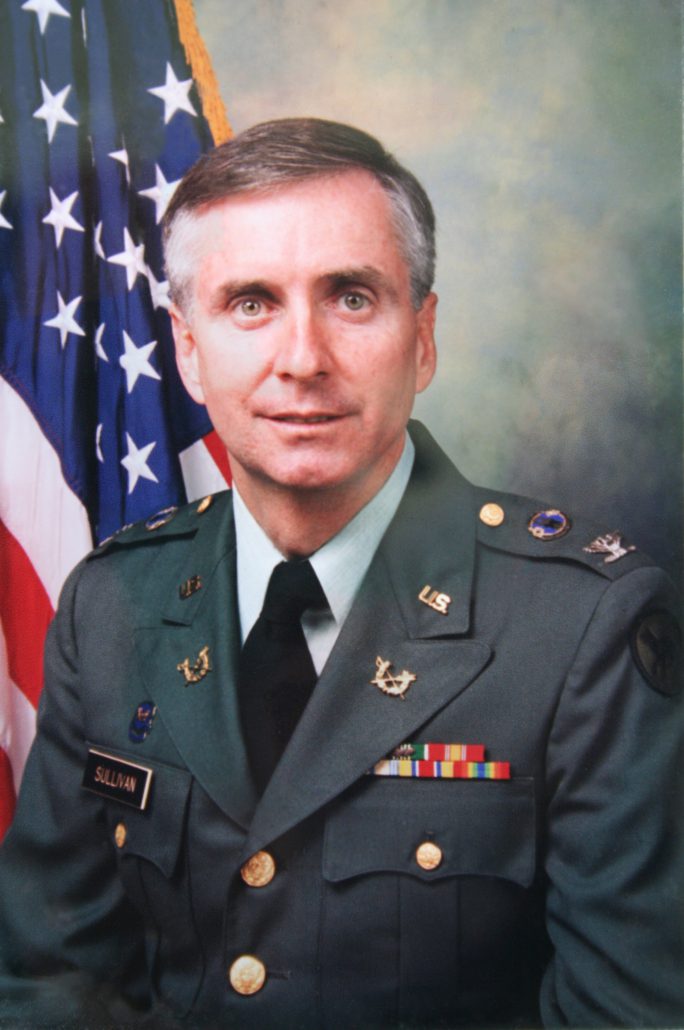
 

Colonel William F. Sullivan

Bill Sullivan, U.S. Army Colonel, Retired
Westlake Resident

Bill was drafted in 1969 and reported for induction at the AFEES station in Jacksonville, Florida just as Neil Armstrong was taking man’s first step on the moon. From there, he was sent to Fort Dix, New Jersey, for basic training at a Private E-1. Bill graduated nine weeks later and received his officer’s commission as a Reserve Army Captain in the Judge Advocate General’s Corps. From Fort Dix, he was sent to Fort Lee, Virginia, for a two-week officer orientation course. Bill’s next assignment was to JAGC School at the University of Virginia for the two-month JAG Basic Course. The group graduated at Christmas in 1969 and received orders to report to their first duty station in January 1970 in Fort Riley, Kansas. Bill worked for a Colonel he respected, so when he was reassigned to Army Headquarters in Okinawa, which was then a Protectorate of the U.S., Bill requested to go with the Colonel. He received his reassignment to Okinawa a few months later. Bill and his wife Judy had their first child at Fort Riley, and when Judy arrived in Okinawa, she was ripe with baby number two, who was born a month later.

Bill’s most memorable assignment was as a member of the Army Homecoming Team, Operation Homecoming, Clark Air Base, Republic of the Philippines, from January 1973 to April 1973. Hostilities had just ended in Viet Nam and the POWs were being repatriated from their POW camps. Many were flown to Clark Air Force Base in the Philippines for debriefing, then to Germany, and then to the States. The Army had its team of doctors, social workers, chaplains, lawyers, and finance officers to deal with any questions or concerns that the men may have had. Bill vividly remembers standing on the tarmac at Clark as the Air Force transports landed and the men came down the boarding ramps. He states that there was not a dry eye in the house. That very scene was repeated many years later as the troops were coming home to Hunter Airfield in South Carolina after the first Gulf War as he stood on the tarmac at Hunter.

Okinawa was his terminal assignment, and after his discharge in 1974, he and Judy, with their two young daughters, moved to Lighthouse Point, Florida. Bill is from Miami, and Judy is from Coral Gables, so moving to South Florida was an easy decision. Bill started practicing law with his fraternity brother Peter Portley in 1974, and they continued to practice together until they both retired in 2020.

Bill’s active-duty career was from 1969 to 1974. He had the foresight to stay in the Active Reserves and retired as a Colonel in 1997. Bill concludes, “I always smile when someone thanks me for my service because I truly feel that I got more than I gave. Judy and I loved the culture of the military community, and we made so many great friends and shared so many wonderful experiences. There is a comradery of military service that is hard to explain unless you have experienced it. Judy and I both loved it, and we will always cherish the memories.”

As we celebrate Armed Forces Day around the nation, we would like to thank all members of the Armed Forces, past and present, for their dedication and service to our country. At John Knox Village, we treasure the many veterans who call JKV home. We’re honored to have them here.

We invite you to visit John Knox Village of Florida to learn more about us and see what sets us apart from other senior living communities. JKV is a life plan community offering an exceptional lifestyle and the financial security of having a plan in place for any future care that might arise.

To learn more, contact us for a conversation or to schedule a tour.