Tag Archive for: pride

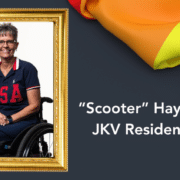
Portrait of JKV resident Scooter Hayes in a wheelchair, official headshot from the U.S. Paralympics

Pride Month Resident Spotlight: “Scooter” Hayes

Paralympian, Veteran, Champion: Scooter Hayes, PLY, Lives Life Large at JKV

Even though Paralympic athlete, fencing champion, and U.S. Army veteran Terry “Scooter” Hayes, 66, has a progressive brain disease, she continues to live life large in every way imaginable.

Scooter served as a heavy equipment operator in the Army from 1977 through 1979. After leaving the army, she shifted gears and became a special education teacher. In 2011, her life took a sharp turn when she was diagnosed with primary cerebellar degeneration — an incurable and untreatable neurological disease that causes nerve cells in the cerebellum, the area of the brain that controls coordination and balance, to deteriorate and die. Today, she is paralyzed from the waist down.

Scooter and her wife, Freda Routt, 73, moved to John Knox Village (JKV) in November 2024, leaving behind their home at the Carefree Resort in North Fort Myers.

For them, JKV is a place where life is not only manageable — it’s vibrant.

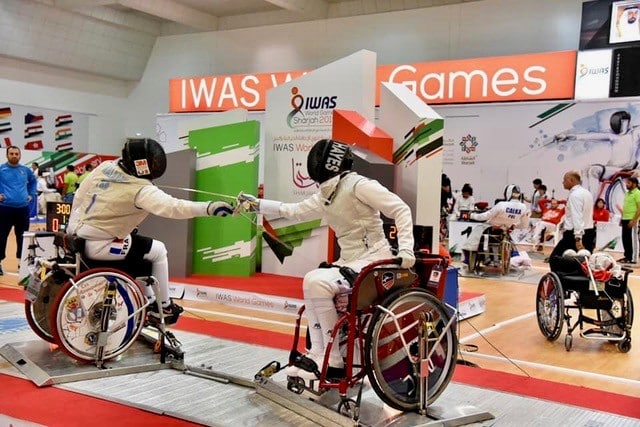
At 58, while searching the internet to find a wheelchair sport she could participate in, Scooter came across wheelchair fencing, now known as Parafencing.  She watched videos and loved what she saw. She began lessons soon after.

The Veterans Administration provided her with a fencing wheelchair, and that gift opened doors she never imagined. “The fencing wheelchair the VA provided has opened the whole world to me,” she says. She was immediately drawn to the sport’s blend of physicality and strategy. “Fencing is a combat sport, a cat-and-mouse game where you must anticipate your opponent’s next move and keep your brain sharp.”

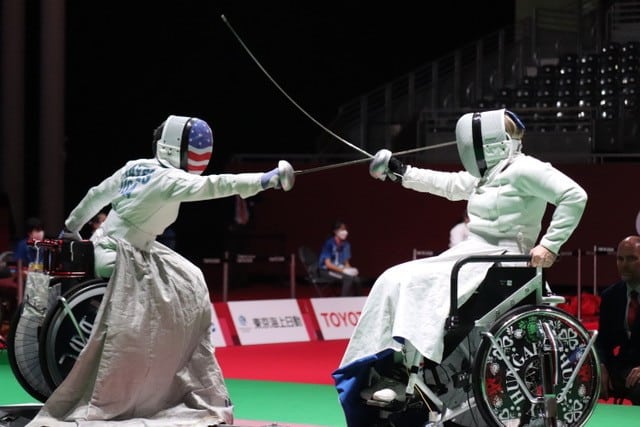
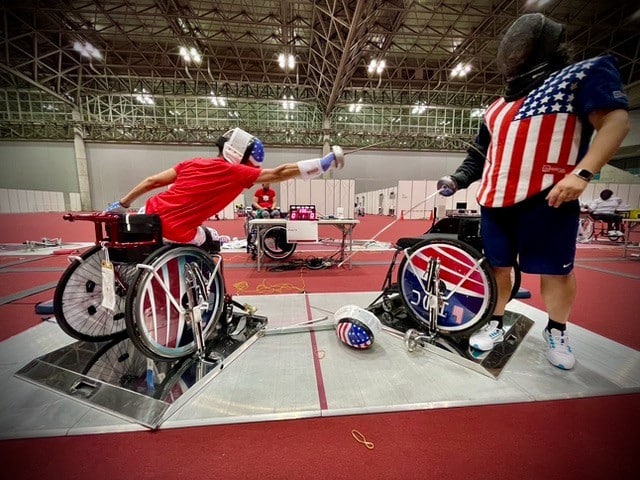
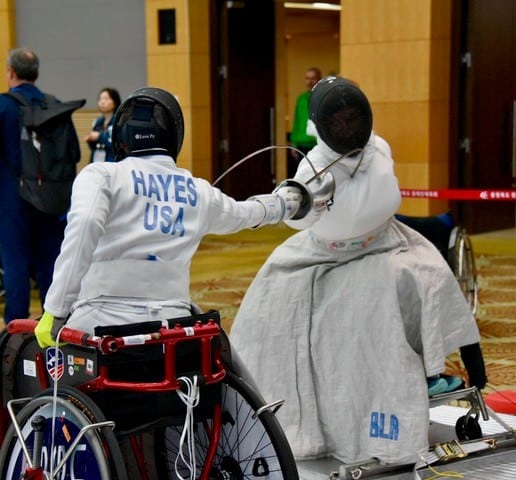
Parafencing was developed for athletes with physical impairments, including those affecting their lower limbs. Athletes compete in fixed wheelchairs, using their upper body strength, agility, and reflexes to score hits on their opponents with a sword. Three types of swords are involved in fencing competitions, Foil, Sabre, and Epee. The sport features individual and team events, both of which Scooter has competed in, using the same three weapons that able-bodied fencers use.

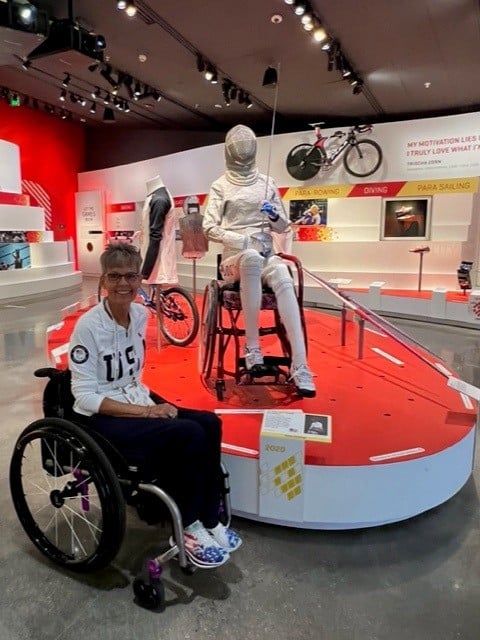
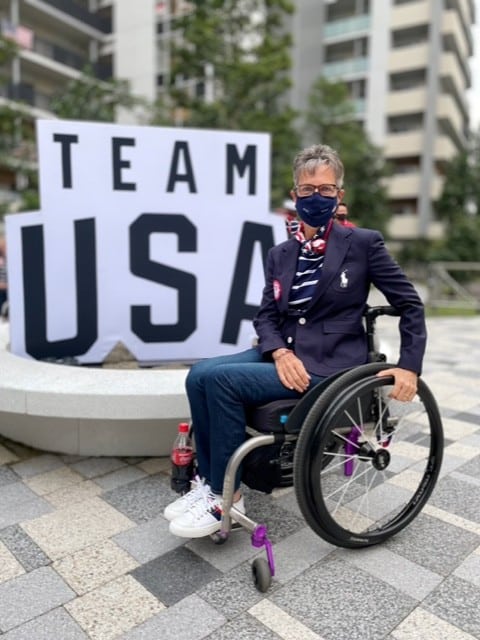
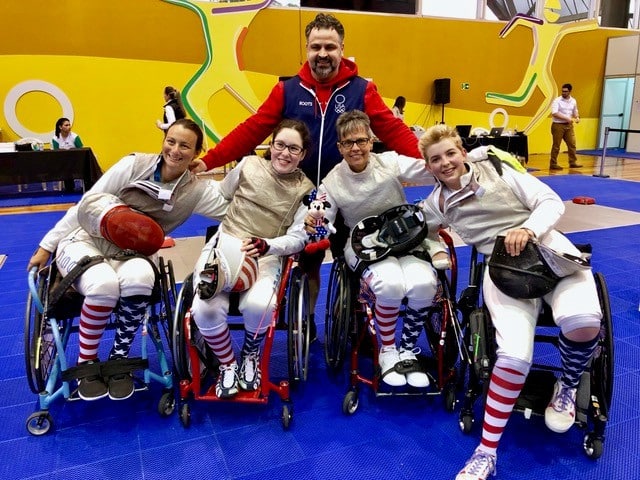
Scooter, who ended up training six hours a day, competed in her first international Parafencing tournament in Canada in 2018. Just one year later, she was selected for The U.S. World Championship Team. In 2020, at the age of 63, Scooter represented Team USA at the Tokyo Paralympic Games — an extraordinary milestone in a remarkable journey.

Throughout her fencing career, Scooter has been able to travel the world along with Freda, always by her side, and always her biggest cheerleader. They’ve trained in Colorado Springs, Colorado, and have competed all over the U.S. and internationally at World Cups in Sao Paolo, Brazil, Warsaw, Poland, Cheongju, South Korea, Eger, Hungary, Amsterdam, and Sharjah, United Arab Emirates.

At the 2020 Paralympics in Japan, as a 63-year-old competitor, Scooter was the oldest team member. There is no age limit for the sport, but one has to be at least 14 years old. And indeed, one of her teammates started at 14.

One of three daughters to her mother and father, who served in the Army, Scooter was born in Nebraska but grew up living on military bases in Germany and around the country. She and Freda met 26 years ago at church in Norfolk, Virginia. Freda, also a veteran who served in the the U.S. Air Force, was an inventory manager before retirement.  Today, Scooter and Freda have found their forever home at John Knox Village.  

As an Army veteran, Paralympian, and a woman who courageously faces tremendous physical challenges resulting from her neurological condition—Scooter is a remarkable inspiration. She lives life on her own terms, never allowing self-imposed boundaries or obstacles to define her journey. Scooter’s story is a powerful reminder of what it means to embrace challenges with resilience and grace. She stands among the many extraordinary individuals who make John Knox Village such a special place to call home—and we are truly privileged to share in her inspiring legacy every day.
 

About John Knox Village (JKV)

For more than 57 years, JKV has set the bar when it comes to delivering an all-inclusive resort lifestyle designed for living life to the fullest at each stage of retirement. JKV emphasizes fitness and overall well-being with world-class programming, state-of-the-art amenities, healthy and delicious dining, and much more. Residents are entitled to unlimited use of healthcare services and 24/7 healthcare professionals on campus. There are no time or financial limits on the long-term care benefits that residents receive, regardless of the level of care required. Simply put, a life plan contract at JKV provides a fiscal safety net with an unparalleled community geared to a wide range of needs for living life to its fullest at every stage of retirement.

Want to learn more about what John Knox Village has to offer?  Contact us today to come visit our campus, or for a no-pressure conversation with one of our Life Plan Consultants.  

Your future, like Scooter’s, can be full of possibility.

Pride Month Resident Spotlight: Terry Colli

Terry Colli moved to JKV with his partner, Jerry Oshinski, in December 2016 and he says that it was one of the best decisions of their lives. Jerry and Terry loved it here, but unfortunately, it was to be short-lived. Jerry passed away in August 2018 after 40 happy years together. As a retired official from a high-level government job as the head of public affairs for the Canadian Embassy in Washington, D.C., Terry remained actively involved in his new JKV community. In 2019 he was recommended by the JKV Resident Senate to become a Resident Board Member, where he still serves today. JKV is shining the Pride Month Spotlight on Terry Colli and his impressive career.

JKV:  Where are you from, Terry?

TC:  I grew up in a small town (pop. 2,800) on the Canadian prairies.  At university, I was attracted to economics, and, after graduating with a B.A., I went on to do a Master’s Degree in economics at the University of British Columbia. Economics was going to be my career when I got a job teaching that subject at the University of Saskatchewan. But two years later the trajectory changed when I got a call to join the Canadian Department of External Affairs in Ottawa.

JKV: Tell us about you and your early career.

TC:  A lot of my career can best be explained as serendipitous because I thought I had a plan – but life got in the way. My progress in the Canadian Foreign Service was routine – until I received a posting to Washington, D.C. Once there, I met the man who would be the love of my life – Jerry.  But to make this relationship work, I had to find a way to get out of the traditional Foreign Service assignment rotation. With good luck, I discovered that the powers that be were looking to create a permanent position in the Embassy that would do a deep dive into the workings of the U.S. economy.  YES!!

A couple of years later, “the fickle finger of fate” was again at work. The Ambassador of the day was without an executive assistant, and suddenly, it was me. Then, the fates really got down to business.

JKV:  What do you mean?

TC:  It happened that a very important visit to Washington by the Canadian Prime Minister was planned.  Suddenly, I was the leader of the Embassy team, preparing all the technical details for the visit. I got the job because more senior players in the Embassy thought I was suitable cannon fodder if things went wrong! But they did not go wrong, and when the smoke cleared, the Ambassador promoted me to the head of Public Affairs – a role I filled at increasing levels of responsibility for the remainder of my career.

JKV:  Can you tell us about a career highlight?

TC:  A top highlight for me was the “Spirit of Haida Gwaii” project. This was a massive sculpture on the folkways and culture of the Haida Gwaii nation of the Queen Charlotte Islands that was to be placed at the entrance of the Canadian Embassy. The sponsor was RJR Nabisco. A handshake with the artist, Bill Reid, set the deal in motion. But over the course of the next three years the cost escalated from $300,000 to $3 million, and the hand-shaker from the corporation was long gone. Pulling the project back from the brink of disaster took some fancy footwork and calling in lots of favors. But it got done – and we celebrated the installation with 60 members of the Haida nation present to bless the sculpture and ensure its happy life.

Spirit of Haida Gwaii, the Black Canoe sculpture outside the Canadian Embassy in Washington, D.C.

Spirit of Haida Gwaii, the Black Canoe, by Bill Reid, outside the Canadian Embassy in Washington, D.C.


JKV: What drew you to John Knox Village?

TC:  As my career was ending, Jerry and I decided that South Florida would be a good place to retire. He had already retired a few years earlier and was spending much of the winter here. Unfortunately, soon after, Jerry’s health was starting to deteriorate, and our large house was more than I could manage by myself. After some exploration, our focus turned to John Knox Village, and at the end of 2016, we officially moved here.

JKV: What have you enjoyed as a Resident Board Member?

TC:  It has been a very active four and a half years. I am proud to have served through the construction of the Pavilion and Westlake, which are major financial investments. The greatest achievement has been overcoming operating deficits and getting to a stable footing where our operating revenues are covering expenses. I am pleased to say that JKV’s future looks bright!


About John Knox Village (JKV)

For the past 50+ years, JKV has set the bar when it comes to delivering an all-inclusive resort lifestyle designed for living life to the fullest at each stage of retirement. JKV emphasizes fitness and overall well-being with world-class programming, state-of-the-art amenities, healthy and delicious dining, and much more. Residents are entitled to unlimited use of healthcare services and 24/7 healthcare professionals on campus. There are no time or financial limits on the long-term care benefits that residents receive, regardless of the level of care required. Simply put, a life plan contract at JKV provides a fiscal safety net with an unparalleled community geared to a wide range of needs for living life to its fullest at every stage of retirement.

Want to learn more about what John Knox Village has to offer?  Contact us today to take a tour, or for a no-pressure conversation with one of our Life Plan Consultants.